 Achal Shah
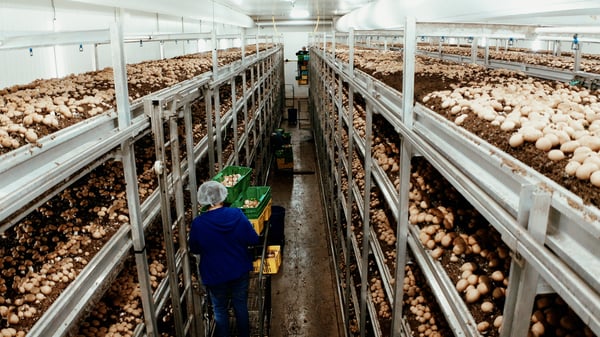
At Amycel, innovation has always been rooted in the real needs of commercial mushroom growers. From spawn development to research and technical support, our work is focused on helping growers improve consistency, performance, and long-term results.
In 1923, a woman in Ocean View, Delaware named Cecile Steele ordered 50 chicks to restock her backyard laying flock. The hatchery sent her 500 by mistake. She raised them in a 16-by-16 shed and sold the meat locally. Within five years there were 500 broiler farms across the Delmarva Peninsula. That is the founding moment of the US commercial broiler industry. 103 years ago. A regional cluster. Family-operated. A side enterprise that grew into a category.
A few decades earlier, in 1885, a florist named William Swayne in Kennett Square, Pennsylvania, started growing mushrooms under his greenhouse benches as a sideline to his cut-flower business. By 1930, there were more than 500 mushroom houses within 10 miles of Kennett, producing roughly 85% of US mushrooms.
A century later, the trajectories look nothing alike. Chicken passed beef as America's number-one protein. The US broiler industry now produces over 62 billion pounds a year, worth more than $60 billion. The US mushroom industry ships about 800 million pounds a year, worth around $1 billion, and accounts for roughly 1% of US vegetable consumption.
Two industries. Same structural starting point. Wildly different outcomes.
Not all of that gap traces back to how the two products are grown. But some of it does and the longer I sit with the broiler playbook, the more it has to teach us.
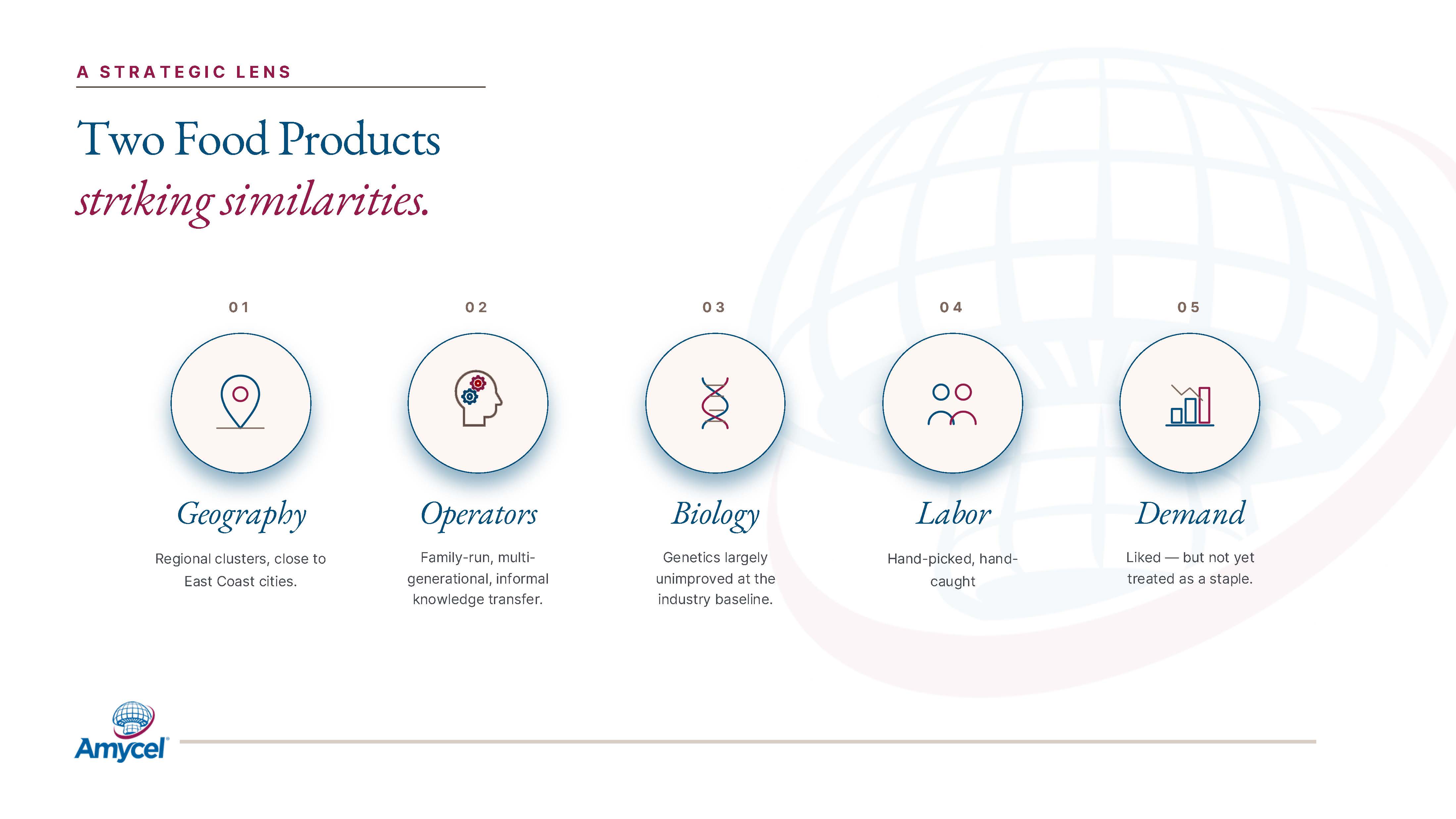
The structural similarities, 100 years ago
Both industries started as regional clusters built on an infrastructure advantage. Delmarva had grain transport by rail from the Midwest, mild winters, and proximity to East Coast cities. Kennett Square had limestone-rich soils, horse manure from the regional racing industry, and proximity to those same East Coast cities.
Both were family-operated and multi-generational. Kids learned from their parents. Knowledge transferred informally through regional density, not through formal R&D programs.
Both were biologically constrained by genetics that had not been seriously improved. The 1925 broiler took 16 weeks to reach 2.5 pounds. The 1925 Agaricus bisporus strain produced a fraction of today's yield with worse uniformity. Neither industry had cracked its core biology.
Both depended on labor-intensive, hand-managed production. Birds were caught and processed by hand. Mushrooms were, and still are, picked by hand.
Both served a category that consumers liked but did not yet treat as a staple.
That is where the symmetry ends.
What mushroom growers are facing right now
Three pressures are compounding across every operation in the industry.
Labor. Harvesting is the most labor-intensive part of any mushroom operation. The American Mushroom Institute's own figure is that labor tops 50% of mushroom production cost, and growers on average operate with only 75% of the workforce they need. Pounds are getting left on the beds because the labor isn't there to pick them. US wage inflation has run roughly 22% cumulative over the past five years. At a 50% labor share, that is about 11 points of margin compression on the wage line alone, before you touch energy or substrate.
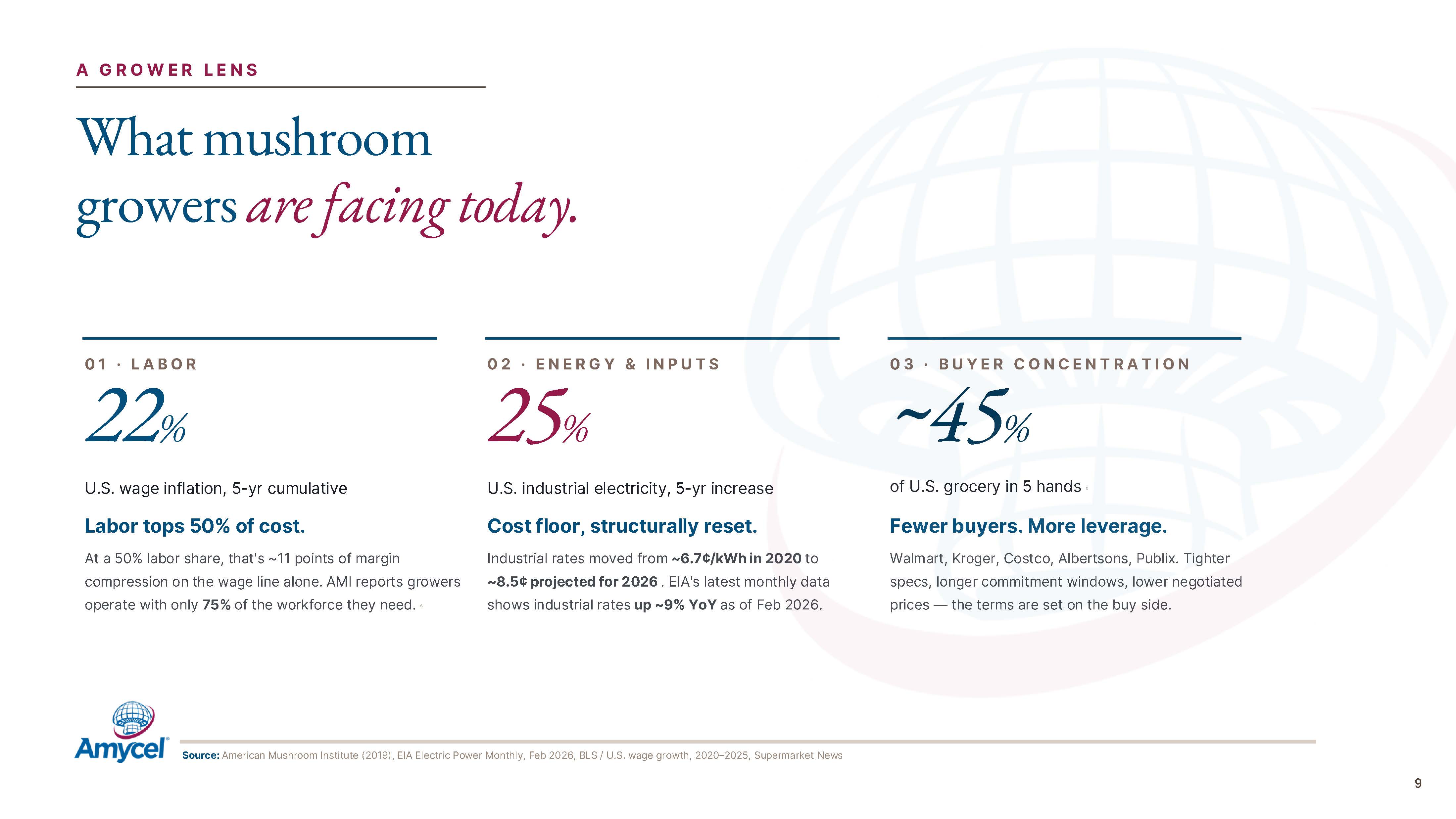 Energy and inputs. Climate rooms running 24/7 at the precision modern production requires are energy-intensive. US industrial electricity has moved from around 6.7 cents per kWh in 2020 to roughly 8.5 cents projected for 2026, a 25% increase in five years. The EIA's latest monthly data shows industrial rates up about 9% year over year as of February 2026. The cost floor of a pound of mushrooms is structurally higher today than it was five years ago, regardless of how well you run your operation.
Buyer concentration. The top five US grocers (Walmart, Kroger, Costco, Albertsons, Publix) control roughly 45% of US grocery sales. Fewer buyers. More leverage. Tighter specs, longer commitment windows, lower negotiated prices. The terms are being set on the buy side.
These are not problems the broiler industry escaped. They are problems the broiler industry confronted decades earlier and decided to engineer around. The question is what they engineered, and what is portable.
Three lessons from the broiler playbook
Speed
In 1925, a broiler chicken took 16 weeks to reach 2.5 pounds. Today, in around 7 weeks it reaches close to 7 pounds. Less than half the time. Roughly 2.5x the weight.
This was not one breakthrough. It was three systems advancing in lockstep: genetic selection for early growth rate, feed formulation that let the bird express its genetic potential, and environmental control over temperature, lighting, ventilation, and ammonia, which removed external constraints on growth.
The early Delmarva broilers were housed in single-story wood-frame structures with natural ventilation and fed a simple dry grain mash. Modern broilers are housed in tunnel-ventilated, climate-controlled, computer-monitored environments and fed phase-specific formulations calibrated to the growth curve of the bird: a starter, grower, and finisher diet matched to what the genetics demand at each stage of development. The genetics, the feed, the control systems and the buildings had to advance together. The broiler industry could have selected for faster-growing birds for sixty years and captured only a fraction of the gain if it had kept raising them in the same conditions and feeding them the same grain mash.
For mushroom growers, the parallel is investing in advancing four key components in lockstep: genetics, compost, control systems, and infrastructure. While genetic selection is critical, the full benefit of that advancement can only be captured if the other systems evolve to support it. If genetics advance 2x over the next decade, how would your approach to compost, control systems, and infrastructure evolve to capture the genetic gains?
Consistency
This is the pillar that converted broilers from a commodity into a contracted ingredient. It is also what explains why chicken passed beef as the top protein choice
In the 1950s, KFC and the early QSR chains could not standardize their menus on broiler birds because bird-to-bird variability was too high. Carcass weights varied. Breast yields varied. You could not build a McNugget on that.
What Tyson, Perdue, and Pilgrim's figured out is that the criterion that mattered for industrial buyers was not average performance. It was tight distribution around the average. They selected aggressively for uniformity. Bird after bird, the same size, the same conformation, the same yield curve. That is what made automated cutting lines possible. That is what made portion-control contracts possible. That is what made 52-week supply commitments to McDonald's, KFC, Walmart, and Costco possible.
For mushroom growers, the question is sharp. The top five grocers are not paying premiums for higher average yield from your operation. They will likely pay premiums for tight distribution: predictable cap size, predictable pack-out, predictable harvest windows, predictable 52-week supply. Are you optimizing for average yield, or for distribution tightness, and do you know which one your buyer is actually paying for?
Uniformity is what enabled the McNugget. What would it take to enable the MycoNugget?
Profit
In broiler, feed conversion ratio dropped from roughly 3.0 in 1950 to about 1.7 today. Feed is over 60% of broiler production cost. Every 0.1 improvement in FCR drops cost per pound meaningfully.
Here is what that compounding did. In 1960, retail chicken was around 60 cents a pound and retail beef sirloin was 83 cents. Chicken was cheaper, but only by about a third. Today retail chicken is roughly $2 a pound and retail beef sirloin is roughly $8. The gap went from a third to four-fold. That, more than any marketing campaign, is what put chicken on top of the consumption charts.
The FCR gain did not come from operational tweaks or growing practices. It came from 2 to 3% annual genetic gain, held over 60 years, by operators who stayed in the program. Two percent compounded annually for sixty years is about a 3.3x improvement, which is roughly what FCR delivered. The operators who built deep feedback relationships with the R&D teams at their genetics suppliers gained the most.
Most mushroom operations evaluate spawn on a one-to two-month window: yield, quality, price. That is a procurement frame. Broiler integrators evaluate genetics on a ten-to fifteen-year window because that is where the compounding shows up.
The argument is not "buy more spawn." The argument is to decide whether you are a spawn buyer or a genetics partner, and that decision applies whether you work with us at Amycel, with Sylvan, or with your own in-house program. Over what time horizon are you measuring the return? How can you truly partner with your genetics provider to build tight feedback loops that enable consistent genetic gain over time?
Three decisions
Every grower has three decisions in front of them right now: their growing environment, their buyer contracts, and their spawn partner.
The broiler industry made these decisions in lockstep with their genetics suppliers, their nutritionists, and their builders. They did not make them fast or perfectly, but they made them together, and the gains compounded over decades.
One industry. Two products. A hundred years. The broiler playbook is on the table. The question for the next decade of mushroom growing is how we can build our own?
What’s Next: Engineering the Mushroom Playbook
The Scientist’s Perspective recognizing a multi-decade opportunity is the first step, but how do we practically execute it from the laboratory and growing room floors?
In our follow-up piece, our R&D and genetic development team peels back the curtain on the science. We break down the precise biological levers, data-driven traits, and genetic advancements required to drive the long-term compounding gains our industry needs to thrive.
Our new blog platform is dedicated to providing the commercial mushroom industry with science-backed, data-driven insights—uncovering the realistic truths of our past to help you make high-stakes decisions for the future.
Stay tuned in. [Click here to subscribe to our newsletter] and read on in Part 2.
FREE DOWNLOAD
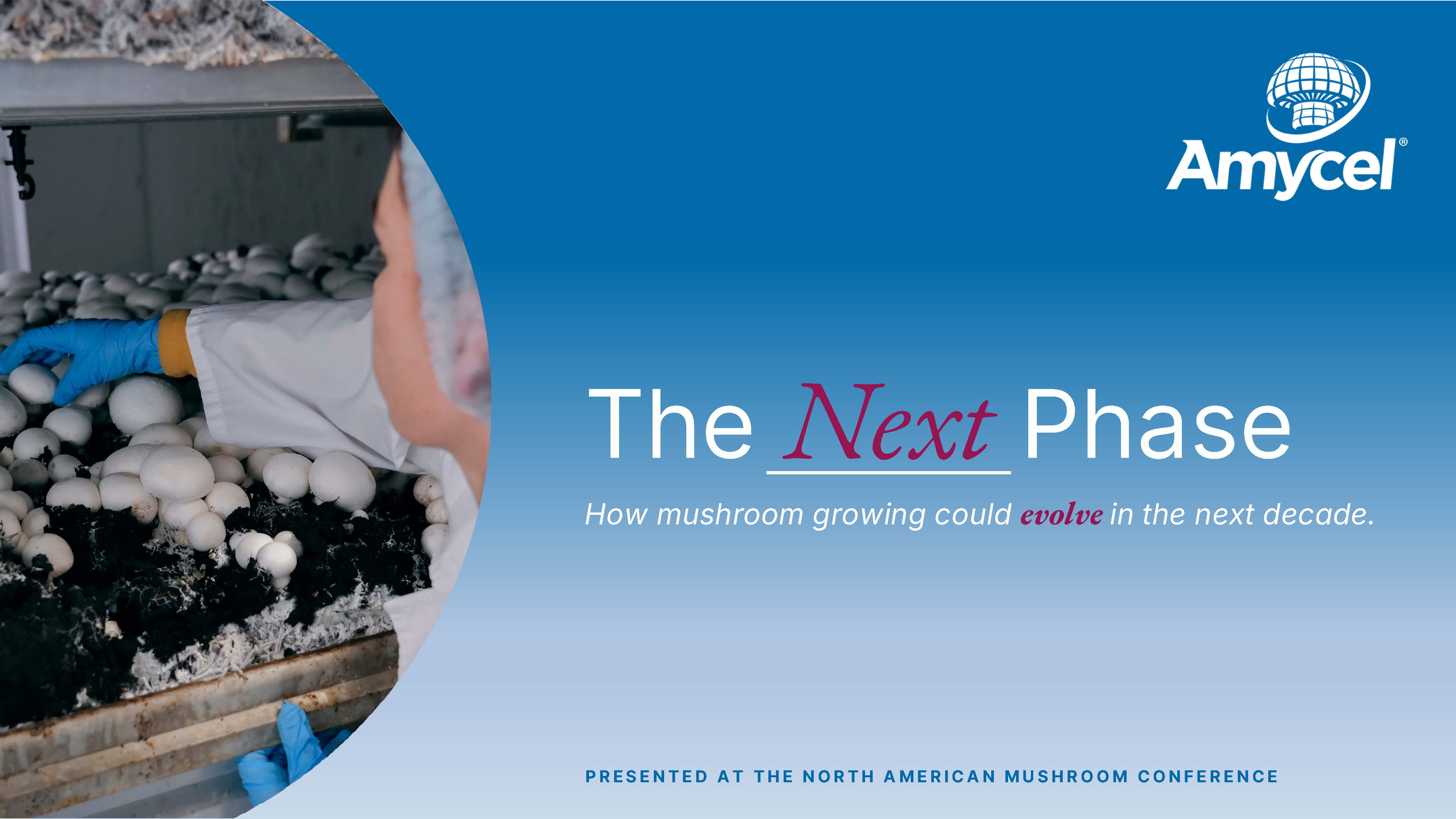
The Next Phase
Complete the form below to download our complete 28-page deck to learn how to optimize your growing parameters for Speed, how to measure Consistency, and how to develop tight feedback loops with spawn manufacturers to drive Profit. Plus, if you wish to take the poll on the next screen, we'd love to hear your thoughts about:
- Which trait category takes absolute priority in your operation?
- What is your organization's current stance on Gene-Editing?
- How would your team prefer to share trial performance data?